God’s time line is in no way our time line. He acts in the sphere of eternity, in His all-knowing, all seeing before even anything takes place, to the time when all begins. In fact, before there was time, He was. Hard for a limited human mind to comprehend such reality. Where there is no beginning and no end, it just floats around our mind, without settling in our understanding. But that is the way it is. For our God is not in the frame of our understanding, being Who He is. This is how the Apostle Paul describes Him: Oh, the depth of the riches and wisdom and knowledge of God! How unfathomable are His judgments! And how untraceable are His ways! For who has known the mind of the Lord and who has understood His thoughts, or who has ever been His counselor? … For from Him and through Him and to Him are all things. To Him be glory forever! Amen (Rom. 11:33-34, 36).
Tag: Salvation
In The World You Will Have Tribulation
(John 16:33)
Just before His trials and ultimately death, YAHSHUA spent time alone with His disciples preparing them to face the world without Him and at the same time warning them of things to come, including persecution. After His last supper with them, He washed their feet with the purpose to teach them humility. In chapter 14 He promises to return to earth to gather His own for Himself and blessed them with His peace; He presented Himself as the only Way to the Father, the Truth that will set man free; and Life. He is the only source of life physical and eternal. In chapter 15 He emphasizes sanctification. Here, He presented Himself as the Vine and the believers as the branches. Apart from the Vine there is no life. He calls their attention to love one another, for it is a commandment that summarizes the entire law – love for God and for others. in chapter 16 He promises the Holy Spirit; He details the nature of His ministry; and gives details concerning future persecution coming against them and encourages them to endure, for He had overcome all for them. He concludes it by saying: In the world you will have tribulation and trials and distress and frustration; but be of good cheer! For I have overcome the world (vs. 33).
The tribulation YAHSHUA mentioned was not concerning the great tribulation, as many Christians think, but it referred to persecution from the world which embraces all those who are enemies of God. If you belonged to the world, YAHSHUA said, the world would treat you with affection and would love you as its own. But because you are not of the world, but I have chosen you out of the world, the world hates you. Remember that I told you. A servant is not greater than his master. If they persecuted Me, they will also persecute you (John 15: 19-20a). Persecution is a sign that the believer is not of this world.
The Ultimate Gift
(Isaiah 53; Hebrews 10: 7,10)
Then YAHSHUA said, Behold, here I am, coming to do Your will, O God, what is written of Me in the volume of the Book; and in accordance with this will we have been made holy through the offering made once for all of the body of Jesus Christ (Hebrews 10: 7, 10).
While He was carrying our grief and sorrow, while He was being wounded for our trespasses and transgressions, while He was being bruised for our guilt and iniquities, while He was taking our punishment and giving us His peace, we stood ignorant and considered Him to be under God’s judgment, rejecting Him to the point of hiding our faces from His appearance, which was marred beyond human form (Isaiah 52: 14). Why do think that was? The reason why, was that we could not stand to see our own sinful condition being put on Him. He didn’t fight back and we thought Him to be weak and marveled at His silence. He was taken away by oppression and falsehood and was led away to the slaughter with criminals, as if He were one of them. He was denied justice and a fair trial. We then, nailed His hands and feet to a tree for six hours when our guilt and iniquities were lighted on Him. With the intensity of His suffering, He cried, Eli, Eli, Lama Sabachthani? (My God, My God, why have You forsaken Me)? (Isaiah 53; Psalm 22)
Bruised, grieved and sickened, God made Him an offering for the sin of the world. Nailed to a tree, His face and body disfigured and poured out like water (in His blood), all His bones out of joint, His heart softened in anguish, no strength left in Him, thirst from dehydration, His tongue cleaved to His jaws, yet He endured the insults of men. “Come down from the tree, if You are the Son of God!” with many other insults they tormented Him. But again, they could never understand that the horror they had seen in YAHSHUA’S face body were indeed the reflection of their own sins He was taking upon Himself. They failed to accept that He was the perfect gift to them- the ultimate gift God was giving to the world– the gift of forgiveness.
A Blind Man Who Would Not Give Up
(Mark 10: 46-52)
Then they came to Jericho. And as He was leaving Jericho with His disciples and a great crowd, Bartimaeus, a blind beggar, the son of Timaeus, was sitting by the roadside (Mark 10:46). It was a regular day for Bartimaeus that day when he, as his daily routine, sat by the road side to beg. His physical dark world impaired him to be part of society.
When he would have a job to provide for his family; it would have supported his social life with friends and family. It was a lonely life for Bartimaeus in his world, lacking the most basic thing of life- his eyesight. His song echoed in the ears of people a monotonous melody, which many had closed their ears to. In a repetitious melody and words, he would ask help for the poor blind man, using the pronoun on the third person. But that day his ears perked up when he heard noises from a crowd coming toward him. For a moment he stops his song, instead, he asked, what was happening? When he heard that it was YAHSHUA of Nazareth, he began to shout, saying, YAHSHUA, Son of David, have pity and mercy on me (Mark 10:47). Remarkably, this poor blind man had knowledge of Whom YAHSHUA was, while Israel as a nation was left in the dark of their spiritual understanding concerning YAHSHUA, for their hearts were callous toward Him. Bartimaeus, from the depth of his soul proclaimed YAHSHUA to be the Messiah- coming from the line of David, as it was prophesized. He must have learned from others about YAHSHUA’S work of miracles, miracles that marked and determined Him to be the promised Messiah. He did not have to see YAHSHUA to believe Him. That was the faith he had, that sprung a belief in his own healing. Nothing would stop him from shouting the prophetic words, “You, Son of David, have pity and mercy on me!”
Who Has Believed Our Message?
(Isaiah 53)
Who has believed our message and to whom has the arm (power) of the Lord been disclosed? (Isaiah 53:1). A question that has been echoed for thousands of years in the ears of mankind. The Prophet Isaiah uttered the message of the coming Savior in a far distant future, with descriptions of His sufferings, at the hands of wicked men. In the early days of the church, an Ethiopian was found reading the passage of Isaiah 53, without the understanding of Whom was that referring to. A Gentile with an enormous curiosity and desire to know and understand the question set in the beginning of the chapter, Who has believed our message? Of whom does the prophet speak? Himself or someone else? He asks the apostle Philip, who after been guided by an angel of the Lord to go to a certain place, there, he met that Ethiopian. Philip then asked him the question, do you understand what you are reading? To what he answered, How is it possible for me to do so unless, someone explains it to me? He said, I beg of you, tell me about whom does the prophet say this, about himself or someone else? (Acts 8:26-34). After Philip explained the message he was reading, the eunuch believed it and was baptized. That was the message of love- a gift of salvation through God’s Son, Whom Philip knew personally and had witnessed Him agonizing at the garden before His trials, and death.
But Mary Stood Alone Sobbing
YAHSHUA was dead; His body was not in the tomb, Mary Magdalene puzzled over what she was seeing, without understanding what had happened on that early morning of the first day of weeks. Without any delay, she ran to tell Simon Peter and John about it. Anxiously and worried, Mary related to the disciples that they had taken YAHSHUA’S body; she did not know where to. Her heart was disturbed and fearful with the idea that YAHSHUA’S body had disappeared. While the disciples went to verify her report, they left also puzzled, for not having understood the words of YAHSHUA concerning His resurrection in three days. Meanwhile, Mary remained at the tomb sobbing, overtaken by her emotion at the thought of Him been gone. She stood at the tomb alone, for the disciples had left at the reality of the empty tomb; they pondered over the fact, for their understanding was veiled with unbelief. As of today, not all Israel has yet been unveiled to see and perceive YAHSHUA been risen from the dead. But for Mary Magdalene, that was all a different story. Delivered from seven demons, she lived her freedom displaying her gratitude to the Lord, as in together with other women, she ministered to and provided for Him out of her property and personal belongings (Luke 8:2-3). Her love for YAHSHUA was clearly genuine, even when she thought Him to be dead.
One Out of Ten
(Luke 17:15-19)
As He was going into one village, He was met by ten lepers…and they raised up their voices and called, YAHSHUA, Master, take pity and have mercy on us! Vs.12-13. That was a cry that came deeply from the hearts of those ten lepers. Leprosy is an infection caused by the bacteria called, myocardium leprae. This bacterium causes damage to the nerves, respiratory tract and to the eyes. It is a slow, and progressive disease. Leprosy overshadows their victims for long period of time, depraving them from the joys and normality of life. They have no life at all; their isolated life defines them as rejected and forsaken by society and the world. Away from family, friends and society, they live in caves, while they watch their bodies deteriorate one limb at a time. Every morning they wake up to a hopeless day. These lepers were in desperate need of the Lord’s touch. A day had finally come for these ten lepers with shinning hope; hope found only in the One Who could heal them. These lepers were in desperate need of the Lord’s touch. However, their pain was not hidden from YAHSHUA, Who on His way to Jerusalem, He took the route that would lead to them, which was through the border between Samaria and Galilee. Going to a certain village, YAHSHUA was met by these ten lepers. Not being able to approach Him, they cried loudly in desperation, YAHSHUA, Master, take pity and have mercy on us! The cry of these ten lepers echoing through the waves of time, with just a few words, was heard in heaven, as they directed it to YAHSHUA, Master. That was the most important prayer of their lives in connection with their health situation. That reminds me of another cry and this time from a blind man when he heard that YAHSHUA was nearby. Although censured and reproved, he kept on shouting out all the more, You Son of David, have pity and mercy on me! (Mark 10: 46-52) In his cry this blind man proclaimed YAHSHUA to be the Messiah when he shouted, “Son of David!” It was Amazing! This blind man was physically blind, but he could see beyond with his spiritual eyes. His faith sparkled brilliantly when He announced YAHSHUA to be “Son of David.” At that, the crowd rebuked him, but he would not stop shouting the tittle, “Son of David” have pity and mercy on me!
When YAHSHUA saw the ten lepers, He said to them, Go and show yourselves to the priests. And as they went, they were cured and made clean (Luke 17:14). At YAHSHUA’S command, Go, they went. That was the step they had to take to receive their healing. No hesitation, no doubt and then they were clean! Something was missing in their lives however, when they did not return to thank YAHSHUA, except one, who upon seeing that he was cured, turned back, recognizing and thanking and praising God with a loud voice; and falling prostrate at YAHSHUA’S feet, thanked Him and he was a Samaritan (Luke 17:15-16). Interesting observation YAHSHUA made, when He asked the question, Were not ten cleansed? Where are the nine? Was there no one found to return and to recognize and give thanks and praise God except this alien? That was a rebuke to the Jewish nation, represented by those nine lepers. Out of ten, only a Samaritan turned around to acknowledge his healing; praise and thank the Lord.
Expression
Love, I saw your appearance
You were so disfigured
In an expression so deep
Beyond comprehension
Of a human mind
Love, you touched me
Penetrating my inmost being
I noticed your suffering
And not knowing what to say
I cried my God!
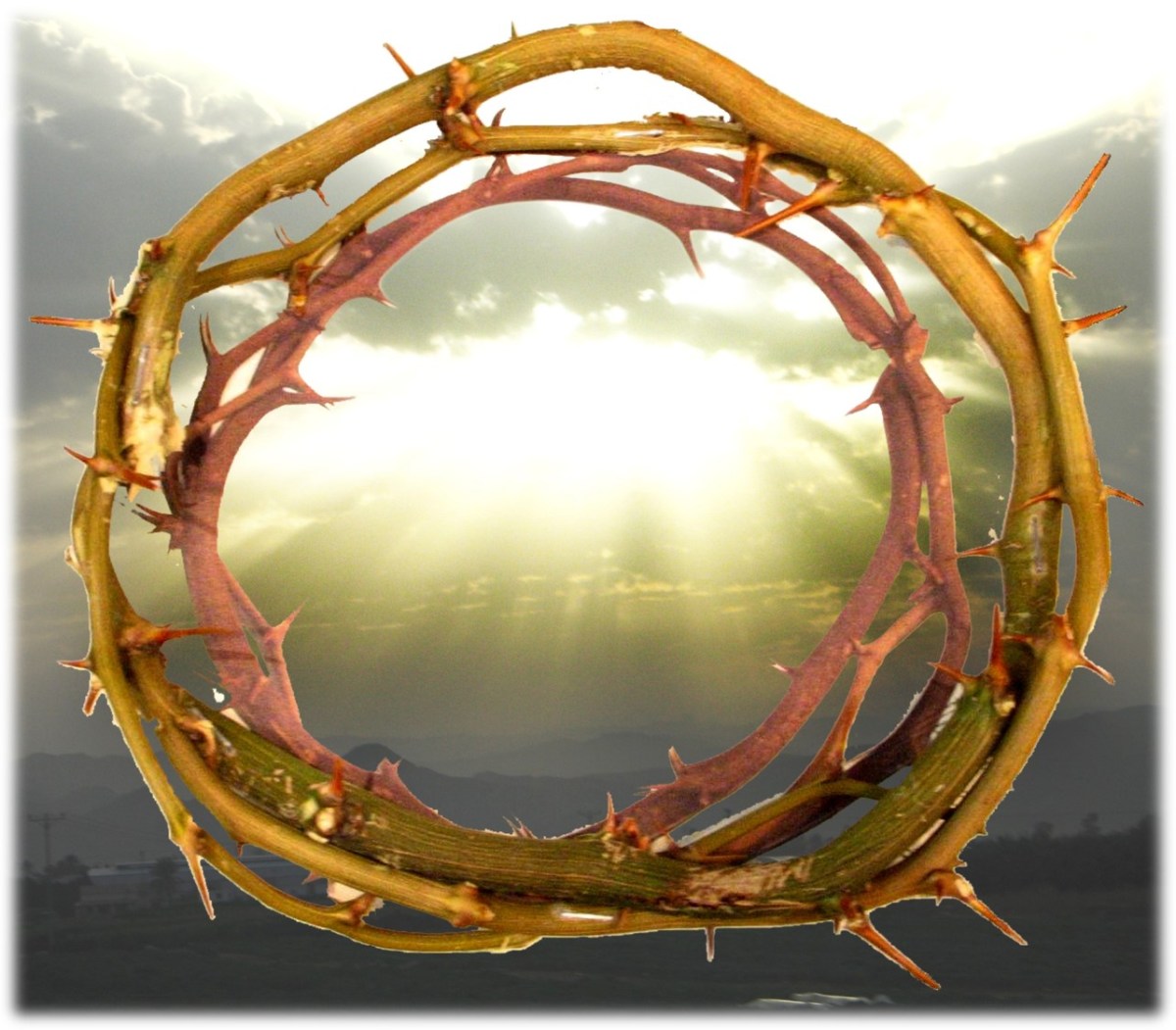
The crown of thorns piercing
Through your head
Causing your blood to flow
Your eyes speaking to me
In an expression so deep
Embracing me, I heard you
Say, Father forgive her
In an expression so deep
I bowed down, touching your feet
Wanting to understand such love
The Man from Gennesaret
His name, I don’t know
But this thing I know
That for a long time
He was in bondage
To demons, I mean
Naked and destitute
From society and family
He lived in tombs
Fear ran over the town
His life a scary thought
To those all around
Until one day Someone
Greater than the demons
Within him came and
Touched his life
With love and freed him
Evidence That Demands Belief
(John 9, 10)
As He passed along, He noticed a man blind from his birth. His disciples asked Him, Rabbi, who sinned, this man or his parents that he should be born blind? (John 9:1,2).
What is so significant about this question? It refers to the visitation of iniquity of the fathers upon the children and the children’s children, to the third and fourth generation (Exodus 34: 7b). Diseases are connected with sin. From the time the first couple sinned, mental and physical sufferings entered the world as a result. But that was not the case in this blind man’s life, as YAHSHUA answered the question, It was not that this man or his parents sinned, but he was blind in order that the workings of God should be manifested in him (vs.3). On the contrary, this man was chosen to fulfill God’s purpose in point and time of his life, “in order that God’s workings be manifested in him.” All the years of his existence he survived through begging. In those days nothing was made easy for a blind person to live a normal life in society, as it is available today. Today a blind person can go to special schools to learn how to read and write through a method called braille and how to live a normal life and be part of the society’s work force. Although still in visual darkness, knowledge lights up his understanding of his surroundings and beyond. His success depends on his willingness to face the world with what it offers him.
 Light from the Word